
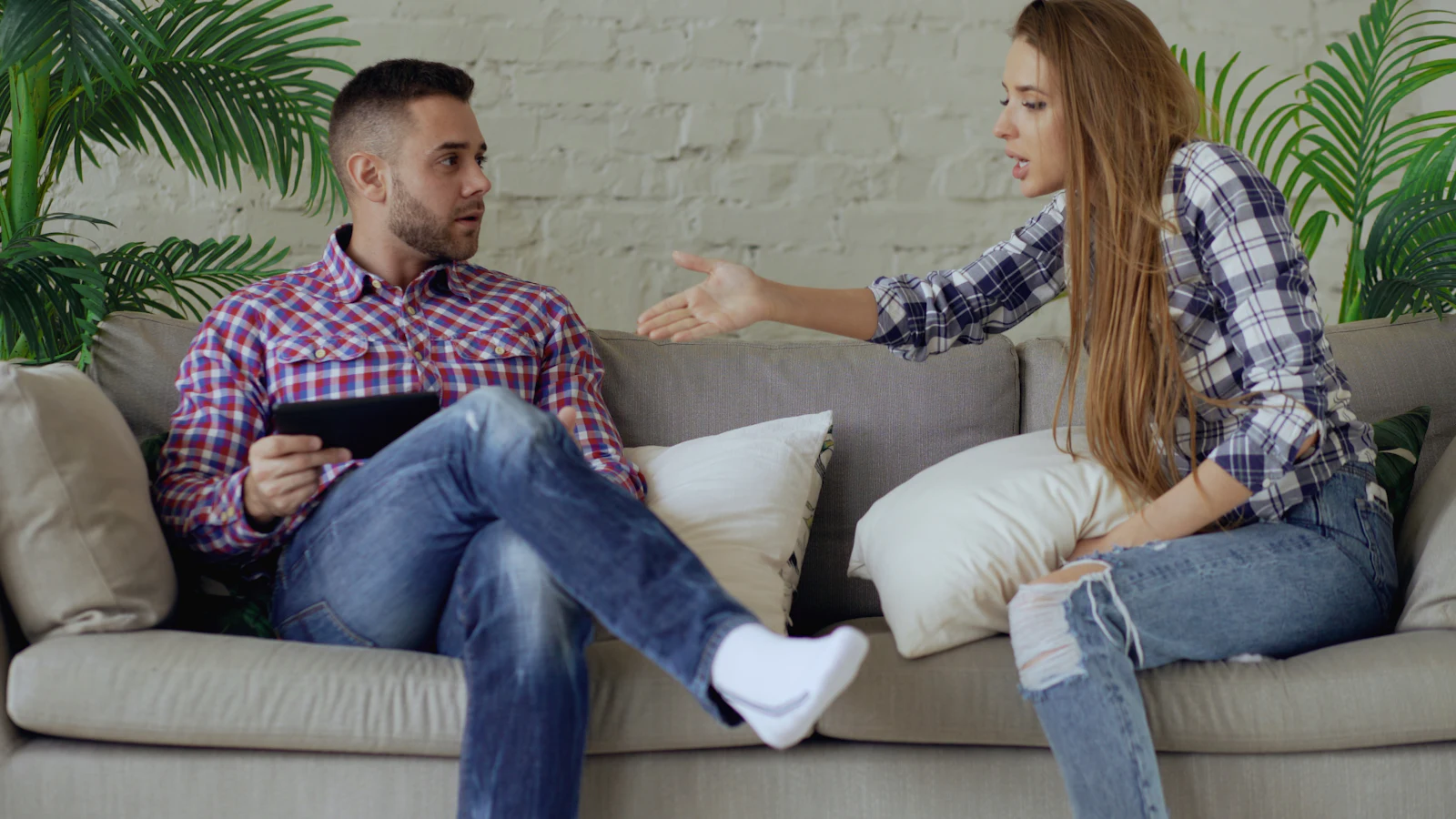

A normal relationship problem is one you can raise, and disagree about, without being afraid of what your partner will do. It is something more serious when their behavior makes you afraid, or controls who you see, where you go, your phone, your money or your body. That calls for specialist support, not relationship advice.
Key takeaways
- The line is fear and control, not how much you argue.
- Control reaches everyday things — who you see, your phone, money, sex — and it can be there with no physical harm at all.
- You don't have to be sure, or have a word for it, to talk to a specialist: the services on this page describe themselves as confidential and open at any hour.
Written byAditi Bajpai, M.A. Clinical Psychology·Published Oct 13, 2026 · Updated Oct 13, 2026·Editorial policy·How we review content
- Reviewed by a licensed counselor
- No sales pitch — care routing only
If someone checks your phone or computer: the National Domestic Violence Hotline's own site carries this warning: “Internet usage can be monitored and is impossible to erase completely.” Phones aren't exempt: “Cell phones can be used to track your location and retrieve call and text history.” It points to safer computers, such as one at a public library, where the services' online chat can be used. For private calls it suggests considering a pay-as-you-go phone kept in a safe place. And it says to clear your browser history after reading.
Are you in danger right now?
If you're in immediate danger, or having thoughts of suicide or of harming yourself, the emergency options in this box come before anything else on the page.
If you need help now
If you are in the US and having thoughts of suicide or self-harm, or need crisis support, call or text 988 or use 988 online chat. For an immediate life-threatening emergency, call 911. Outside the US, contact your local emergency or crisis service. Coaching, venting and a therapy waitlist are not emergency services.
See suicide prevention helplines for your countryFor fear, control or harm from a partner, these are the specialist services. Each describes itself as open at any hour.
Specialist support, at any hour
| Service | Call | Text | Chat |
|---|---|---|---|
| National Domestic Violence Hotline | 800.799.SAFE (7233) | START to 88788 | thehotline.org |
| love is respect | 1-866-331-9474 | LOVEIS to 22522 | loveisrespect.org |
| RAINN — National Sexual Assault Hotline | 800.656.HOPE (4673) | HOPE to 64673 | rainn.org |
Not sure which? Start with the first.
First: do you ever feel afraid of your partner, or pressured or controlled by them?
If yes: that is more than an everyday problem. Go to where to get specialist support; the rest of this page can wait. If you're in danger now, use the emergency options.
If you're not sure: keep reading. The next sections describe what to look at, and the section on not being sure says what you can do without deciding anything.
If no: read what makes a problem an ordinary one, and see whether it sounds like yours.
What makes a relationship problem an ordinary one?
It isn't the size of the problem: ordinary problems can be heated, repetitive and painful. The service love is respect, a project of the National Domestic Violence Hotline, starts from the same place: “Conflict exists in all relationships. By conflict, we specifically mean verbal disagreements and arguments.”
What makes a problem ordinary is what stays true while you're having it:
- You can say what you think, including “no,” without being afraid of what your partner will do — and without editing what you say, wear or do to head off their reaction.
- The argument stays on the issue. In love is respect's words, arguments “shouldn't turn into personal attacks or efforts to lower the other's self-esteem.”
- Each of you still runs your own life: who you see, where you go, what you spend, what you wear.
- Your no is an answer: to sex, and to anything else that is yours to decide. It isn't the start of pressure.
- Neither of you physically hurts, threatens or keeps track of the other.
If these hold, even in a bad month, it reads like an everyday problem. Check it against the signs below before you settle on that.
When is a relationship problem something more serious?
A relationship problem is something more serious when fear or control comes into it. The same service puts the line in one sentence: “If you can't express yourself without fear of retaliation, you may be experiencing abuse.”
The National Domestic Violence Hotline defines what it deals with as “a pattern of behaviors used by one partner to maintain power and control over another partner in an intimate relationship.” You don't have to wait for a pattern before you ask about one thing that frightened you.
Fear isn't the only word for it. It can be dreading their reaction before you bring something up, rewriting a message so it won't set them off, or changing what you say, wear or do to head off a reaction.
This page describes behavior. It doesn't say what your partner is or what your relationship is: that is yours to weigh, and an advocate — the person who answers when you contact one of the services below — can help you do it.
None of this depends on gender, yours or your partner's. In the Hotline's words: “Anyone can be a victim — or perpetrator — of domestic violence.”
What are the signs of a controlling relationship?
The signs of a controlling relationship are behaviors: a partner who decides who you see, goes through your phone or tracks where you go, controls your money, pressures you about sex, threatens or hurts you, or makes you afraid. The table lists behaviors, not types of people. They are among the ones the National Domestic Violence Hotline and love is respect list, grouped here by the part of your life they reach.
| Part of your life | What it can look like |
|---|---|
| Your time and the people in it | Keeps you from seeing friends or family, or discourages you from it. Tells you what to do or what to wear. Stops you from working or going to class, limits your hours, or takes your keys or car so you can't get there. |
| Your phone and your movements | Looks through your phone, or insists on your passwords. Texts you constantly, or leaves you afraid to be away from your phone in case it angers them. Uses social media, spyware or GPS to track where you go and what you do. Demands to know where you've been, who you talked to and how you spent your time. |
| Money | Takes your money, or has your pay go into an account you can't use. Gives you an allowance and wants receipts. Keeps you from seeing the bank accounts, or refuses money for things you need. |
| Sex and your body | Forces sex or a sexual act. Keeps pressing after you've said no, or leaves you afraid of what a no will bring. Demands sex as proof that you love them, or threatens to cheat or leave. Refuses condoms, or gets in the way of your birth control. Pressures you to send explicit photos or videos. |
| Words and threats | Calls you names, insults you or humiliates you — alone, in front of other people or online. Accuses you of cheating, or cheats and blames you for it. Threatens you, your children, your family or your pets, with or without a weapon. Threatens to hurt themselves if you end it. |
| Force, and the fear of it | Hurts you physically, in any way. Has explosive outbursts of temper. Intimidates you with threatening looks or actions. Throws things, punches walls or breaks what's yours. Keeps you from leaving, or from calling for help. |
| Following and showing up | Watches or follows you. Shows up uninvited where you live or work. Keeps sending messages you don't want. |
On its own list of warning signs, the Hotline adds that “even one or two of these behaviors in a relationship is a red flag that abuse may be present.” So this isn't a quiz, and no number of rows makes it count or not count.
What is the difference between an ordinary disagreement and controlling behavior?
The difference isn't the subject you disagree about. It is whether one of you ends up afraid, or no longer free to decide. Topic by topic:
| The topic | An ordinary disagreement | Something more serious |
|---|---|---|
| Friends and family | You disagree about how much time goes to friends, and you still see the people you want to see. | They stop you from seeing people, or keep discouraging you from going. |
| Phones and texting | One of you wishes the other texted more, or less. | They go through your phone, insist on your passwords, or you're afraid to be away from your phone in case they get angry. |
| Money | You disagree about what to spend on, or about who pays for what. | They take your money, decide what you're allowed to spend, or keep the accounts where you can't see them. |
| Sex | You want it at different times or in different amounts, and a no is respected. | A no is ignored, or followed by more pressure or a threat to cheat or leave. |
| Arguments | You both argue, sometimes heatedly, about the thing itself — and you aren't afraid of what comes after. | You're afraid of what they'll do. Their temper explodes, or they threaten you, break things or keep you from leaving. |
| Jealousy | One of you feels jealous and says so, and it stays a feeling the two of you talk about. | Jealousy becomes accusations of cheating, checking up on you, or rules about who you can talk to. |
| “Boundaries” | They say what they need, and you stay free to decide what you do — with nothing to fear either way. | What they call a boundary is a rule for you: what you wear, who you follow, where you go. |
| Big decisions | You disagree about a shared decision, like a move or a lease, and neither of you is rushed or overruled. Your job and your classes stay yours to decide. | They decide for you — whether you work, whether you study, where you live — or keep pushing until you give in. |
The middle column doesn't clear a relationship, and one cell on the right is enough to take seriously. Being afraid of your partner, or shaping your day around their reaction, outweighs every row here.
If nothing in the signs or the right-hand column is familiar, and the ordinary section fits, the relationship problems guide is where everyday problems are sorted by situation.
What if you're not sure whether your partner's behavior is controlling?
Then you don't have to decide before you ask. In love is respect's description, relationships are a range, not two boxes: “All relationships exist on a spectrum from healthy to abusive, with unhealthy relationships somewhere in the middle.”
You don't need proof, a name for what's happening, or a decision about the relationship. The Hotline says its advocates “discuss your situation and help you determine if your relationship might be abusive.” “I'm not sure this is okay” is enough to open that conversation — by phone, text or chat, whichever feels safest to you.
Where can you get help when you're afraid of your partner, feel controlled, or aren't sure?
Three US services do this work. Each can be reached by phone, text and online chat, and each describes itself as confidential and open at any hour. Their numbers and chat links are in the box below the list.
- The National Domestic Violence Hotline — for anyone affected by a partner's behavior. In its own words: “Our services are always free and available 24/7.” Its advocates can talk with callers in “more than 290 languages,” with an interpreter. It hears from people living with these behaviors, from worried friends and family, and from people who want to change how they treat a partner.
- love is respect — a project of the Hotline, made for young people. It offers “confidential support for teens, young adults, and their loved ones.”
- RAINN's National Sexual Assault Hotline — if what happened involves sexual assault or abuse. It describes its service in three words: “Free. Confidential. 24/7.”
Specialist support, at any hour
| Service | Call | Text | Chat |
|---|---|---|---|
| National Domestic Violence Hotline | 800.799.SAFE (7233) | START to 88788 | thehotline.org |
| love is respect | 1-866-331-9474 | LOVEIS to 22522 | loveisrespect.org |
| RAINN — National Sexual Assault Hotline | 800.656.HOPE (4673) | HOPE to 64673 | rainn.org |
Not sure which? Start with the first.
What happens when you contact a hotline?
You don't need a prepared story. By its own account, love is respect's advocates “listen to your situation, assess how you're feeling in the moment,” and a conversation can include “brainstorming a safety plan together or identifying local resources.” What happens after that is your call. The Hotline says so directly: “Our advocates will never make decisions for you — only you have the right to do that.”
If it matters to you what “confidential” covers, ask at the start. It is a normal first question.
Should you try couples counseling when fear or control is part of the relationship?
No, not where fear or control is involved. The Hotline states its position plainly: “We at The Hotline do not encourage anyone in an abusive relationship to seek counseling with their partner.” One reason its page gives: what is said in the room can be used against you later. Start with an advocate, on your own.
Source: National Domestic Violence Hotline, “Should I Go To Couples Therapy With My Abusive Partner?”, thehotline.org — read October 2, 2026.
If neither fear nor control is part of it, and the question is which kind of help suits an everyday problem, that is a different page: choosing between a relationship coach and a couples therapist.
Where can you get care for your own mental health?
From a licensed therapist, seen on your own and not together. An advocate is the specialist for what is happening in the relationship; if living with it is also wearing on your sleep, your schoolwork or your job, that deserves care of its own, from someone trained and licensed to assess and treat.
The table below lists routes into licensed care in the US.
| If you are… | Practical first step | Why this route |
|---|---|---|
| In immediate danger, or having thoughts of suicide or self-harm | Use the crisis resources shown on this page | This is not a coaching or therapy decision. Nothing else on this page applies first. |
| A student at a US college or university | Your campus counseling center | May be free or already covered by fees, no insurance needed, and set up for exactly this age group. |
| Employed, including part-time at larger employers | Your employer's Employee Assistance Program | May offer a set number of free confidential sessions, separate from your manager, and available quickly. |
| Insured | Your plan's provider directory or telehealth benefit | Your real cost after copay can be far lower than advertised self-pay rates. Check before assuming therapy is out of reach. |
| Uninsured or underinsured | Community mental health centers and reduced-fee or sliding-scale directories | Reduced-fee therapy exists in the US. It can take more searching and more scheduling effort, and it is genuinely licensed care. |
| Unsure where to start | Your primary care provider | A GP or family doctor can assess, refer, and can be the fastest door into the system when you do not know which door to use. |
| In a state where a provider is available | Ventoutt's licensed counselors | Therapy requests join a waitlist. If the wait does not work for you, use one of the routes above instead — that is a reasonable choice, not a failure. |
The therapists Ventoutt works with are in the block that follows, with their licenses and states.
Licensed counselors we work with
If a coach believes licensed clinical care may be more appropriate, they may recommend the user to a licensed therapist. Ventoutt does not take a commission on independently provided therapy.

Katryna Elyse Petty, LPC-A
Licensed Professional Counselor Associate
License No.: 101068
Katryna Elyse Petty is a Licensed Professional Counselor Associate (LPC-A) in Texas, USA (License No. 101068) with an active license valid through 2030, practicing under board-approved LPC supervision. She provides evidence-based therapy for anxiety, stress, and relationship challenges, working with diverse clients to deliver structured and ethical mental health support aligned with U.S. clinical standards.

Zachary Michael Sheeley, ALC
Associate Licensed Counselor
License No.: ALC05892
Zachary Michael Sheeley is an Associate Licensed Counselor in Alabama, USA (License No. ALC05892), licensed by the state board and practicing under the approved clinical supervision of John Thorington, LPC-S. With an active license valid through 2027, he provides evidence-based therapy for anxiety, stress, and personal challenges, delivering ethical and structured mental health support aligned with U.S. professional standards.
Robyn Stail, LPCC
Licensed Professional Counselor Candidate
License No.: LPCC.0024031
Robyn Stail is a Licensed Professional Counselor Candidate in Colorado, USA (License No. LPCC.0024031), credentialed by the Colorado Department of Regulatory Agencies – State Board of Licensed Professional Counselor Examiners. With an active license valid through 2027, she provides compassionate and evidence-based mental health support for anxiety, emotional stress, relationship challenges, and personal growth, while practicing under professional regulatory standards aligned with U.S. counseling ethics and care guidelines.
How to verify a therapist's license in the US
Is relationship coaching the right place for fear or control?
No. Coaching on Ventoutt is for everyday relationship problems, and fear, control or harm from a partner isn't one. The services in the support section are the place for that. For your own mental health, the same boundary applies as everywhere on Ventoutt: Coaching does not diagnose or treat. If you need clinical care, we will help you find it.
If you already talk to a coach here and this page describes your situation, a coach doesn't replace those services: contact one of them first. A coach who thinks you need licensed care can refer you to a licensed therapist.
More on where the line sits: what separates emotional support from clinical treatment, and when Ventoutt isn't the right fit.
What else do readers ask about controlling behavior?
How can you tell if your boyfriend, girlfriend or partner is controlling?
No page can answer that about someone it hasn't met, and this one won't put a label on your partner. What it can do is point at behavior: do they decide things that are yours to decide, keep track of you, or leave you afraid to say no? The signs above group those by kind. If some of it is familiar, an advocate can help you think it through.
Is it controlling if your partner wants to know where you are?
Wanting to know and demanding to know are different things. The National Domestic Violence Hotline lists as monitoring “demanding to know where you go, who you contact, and how you spend your time.” A question that separates them, and that you can answer without trying it: could you leave it unanswered, or say you'd rather not share, without dreading what follows? If the answer is no, that is worth a conversation with an advocate.
Can it be abuse if there's no physical violence?
Yes, by the definitions the specialists use. The Hotline's: “Emotional abuse includes non-physical behaviors that are meant to control, isolate, or frighten someone.” The CDC defines intimate partner violence as “abuse or aggression that occurs in a romantic relationship,” and counts stalking and psychological aggression alongside physical and sexual violence.
Do you have to be ready to leave before you contact a hotline?
No. You can contact one to think out loud, to ask whether something is okay, or to plan, and what you do afterward stays your decision. Leaving isn't a condition of getting help.
What if you want to leave but are scared of what your partner might do?
Then talk to an advocate before you tell your partner, and tell the advocate about any threat that has been made. The Hotline is direct about why: “leaving is often the most dangerous period of time.” That is why the plan comes first. Its advocates, it says, “discuss your situation and help create a personalized safety plan that's right for you.” Whether and when you leave stays your decision. If you're in danger now, use the emergency options.
What if you're worried about how you treat your partner?
Then the Hotline is for you as well: people who want to change how they treat a partner are among those it hears from. If you can't tell whether it's you — or your partner says it is — an advocate can help you sort that out too.
What if you're worried about a friend's relationship?
You can contact the same services yourself. The Hotline and love is respect both say they talk with friends and family, not only with the person in the relationship. Ask the advocate how to bring it up with your friend.
What if the relationship is already over?
If you're still afraid of them, or they keep messaging you, following you or showing up, the services above are still where to start.
Where do you start if any of this is familiar?
With one contact, at a time and on a device that feel safe to you. You don't have to be sure, and you don't have to have decided anything.
Specialist support, at any hour
| Service | Call | Text | Chat |
|---|---|---|---|
| National Domestic Violence Hotline | 800.799.SAFE (7233) | START to 88788 | thehotline.org |
| love is respect | 1-866-331-9474 | LOVEIS to 22522 | loveisrespect.org |
| RAINN — National Sexual Assault Hotline | 800.656.HOPE (4673) | HOPE to 64673 | rainn.org |
Not sure which? Start with the first.
If you're in danger now, the emergency options come first:
If you need help now
If you are in the US and having thoughts of suicide or self-harm, or need crisis support, call or text 988 or use 988 online chat. For an immediate life-threatening emergency, call 911. Outside the US, contact your local emergency or crisis service. Coaching, venting and a therapy waitlist are not emergency services.
See suicide prevention helplines for your countryWhere does this page's information come from?
- National Domestic Violence Hotline — “Understand Relationship Abuse”
- National Domestic Violence Hotline — “Warning Signs of Abuse”
- National Domestic Violence Hotline — “Types of Abuse”
- National Domestic Violence Hotline — “What to Expect When You Contact Us”
- National Domestic Violence Hotline — “Plan for Safety”
- National Domestic Violence Hotline — “Internet Safety for Survivors”
- National Domestic Violence Hotline — “Why People Stay in an Abusive Relationship”
- National Domestic Violence Hotline — “Should I Go To Couples Therapy With My Abusive Partner?”
- love is respect — “Conflict resolution”
- love is respect — “Warning signs of dating abuse”
- love is respect — “Types of abuse”
- love is respect — “Relationship spectrum”
- love is respect — “Get relationship help”
- love is respect — “About”
- RAINN — “National Sexual Assault Hotline”
- Centers for Disease Control and Prevention — “About Intimate Partner Violence”
Read October 2 and 3, 2026. These are the organizations' own published descriptions and guidance. This page quotes or paraphrases them; it isn't a research summary. Source-link destinations checked October 7, 2026. Some sites were confirmed through their official indexed entries when direct access was blocked.